
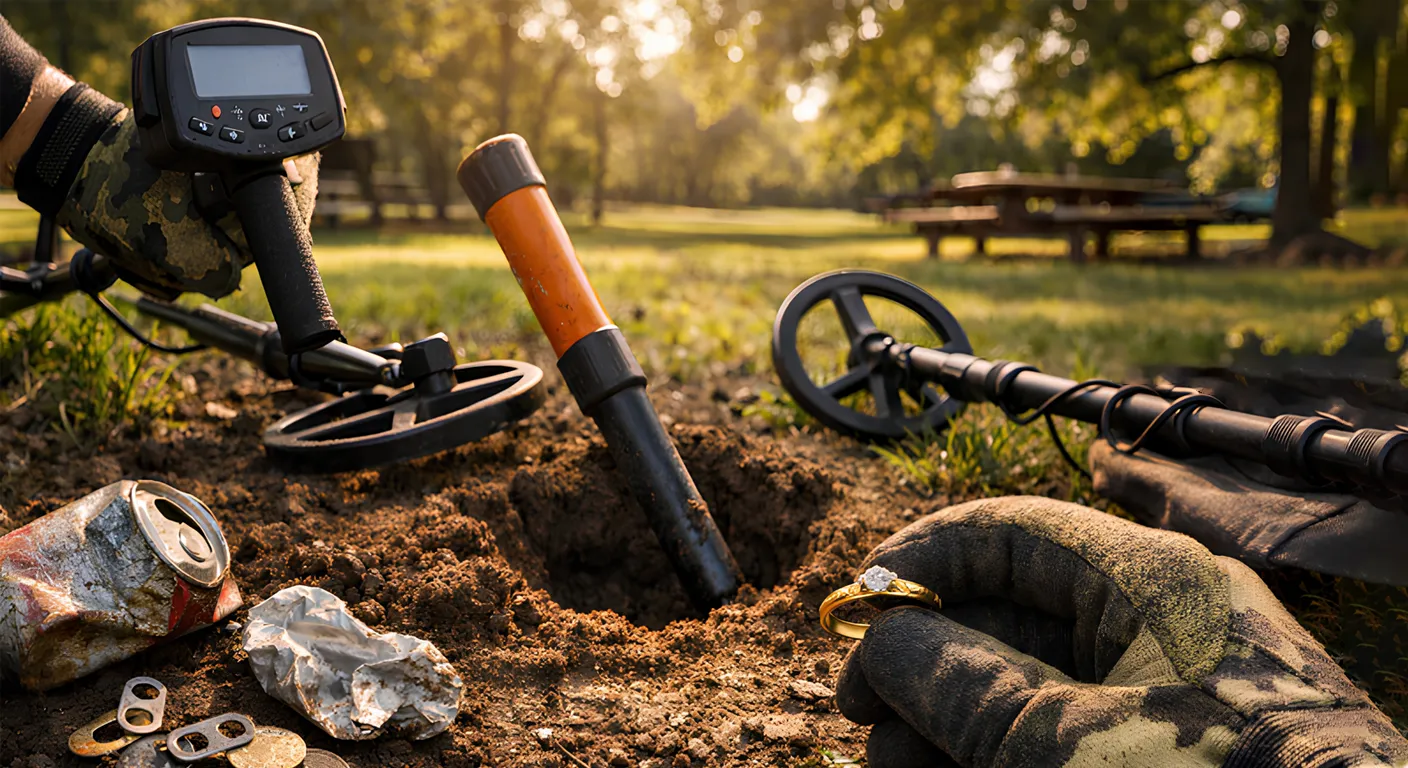
You are in search of a good park, and your detector is heard giving a sharp, clean mid-range tone. You start searching with great enthusiasm, hoping to find a coin or a ring, only to find a flattened can of aluminum. This is the frustrating point since the aluminum is extremely responsive to metal detectors. Aluminum is a good electrical conductor, r hence detectors perceive it as a good target. Aluminum rubbish can also be found over time, particularly in contemporary urban areas.
You cannot just pass over aluminum signals since valuable objects usually have similar ranges. Rings, nickels, and small gold fall near the readings of aluminum. This implies that it is not about luck but skill. You require effective methods that would assist you in assessing cues effectively.
This guide will teach you nine tips that you can use in practice to evade digging through trash that consists of aluminum. With these methods, half or more digs can be saved. You are also likely to increase your odds of locating valuable targets regularly.
Table of Content
ToggleWhy Aluminum Is So Hard to Avoid
Aluminum cannot be avoided since the detectors will show it as a high and stable conductor. It tends to respond to a signal much like precious metals such as gold and nickel. Aluminum wastes in cans, foil, and pull tabs are decades old and can be found in modern places.
Differences in shape and size lead to the generation of numerous signal patterns by aluminum. There is actually some aluminum litter that provides clean, repeatable sounds that promise. Your success will not be based on numbers alone, but rather on reading behavior due to this overlap.

Detector Settings to Start Strong
Before any hunt, you are advised to set up high baseline values so that you can minimize aluminum values and not block out good targets. A well-established system allows you to control the quality of the signal and removes the needless excavation.
1. Set Discrimination Just Above Foil
Adjust your discrimination limit to a little higher than the aluminum foil; most aluminum foils are between VDI zero and five. Foil invents weak, flimsy signals that introduce noise but nothing of value. Such an environment eliminates small pieces of aluminum and retains a mid-range target. When there are ranges of aluminum, there may be gold rings and nickels that are close. This is why discrimination should not be raised too high. Light discrimination preserves precious discoveries as well as minimizes clutter.
2. Use Moderate Sensitivity for Clarity
High sensitivity can be tempted to appear strong, but it will give exaggerated deep trash of aluminum. A moderate level of sensitivity is to be used to ensure clean signal responses. This background enhances better depth and minimization of the false alarms caused by surface debris. Medium sensitivity is also able to stabilize VDI readings, and signal behavior is much easier to interpret.
3. Scan in All-Metal Before Adding Iron Tones
Start every hunt in all-metal mode to learn the situation on the ground and trash concentration. This mode displays the level of activity of the site and also identifies problem areas in a rapid way. The iron tone option is available once you get familiar with the location. The iron tones do not kill any useful information. This strategy is going to make you smarter on the initial sweep.
The 9 Pro Tips to Avoid Digging Aluminum Trash
These tips are concerned with signal behavior, coil control, and site awareness. Both of them enable you to make more intelligent decisions when making a dig without skipping anything valuable.
1. Learn the Can Footprint
Large aluminum items behave very differently under your coil than coins or jewelry. You can identify cans by paying attention to signal width and response duration. When you sweep slowly, aluminum cans hold the signal longer across the swing path.
Coins usually hit sharply and disappear quickly. Rotate your body ninety degrees and sweep again to compare the signal shape. Cans often sound strong from every angle, while coins tighten up. Pinpointing also reveals clues because cans feel oversized and vague.
Depth readings often show shallow depth with unusually loud volume. You save time by learning these patterns early. With practice, you will skip most can targets confidently.
2. Use Smaller Coils in Trash
The smaller coils will provide you with a significant benefit in aluminum-heavy environments. They narrow down the detection field and restrict the problem of multiple targets responding simultaneously. This separation is used to give you a signal rather than a mixture of noises of trash. You have better control when sweeping around picnic tables and walkways.
Smaller coils are also used to sharpen pinpoint accuracy on shallow aluminum. You do not dig wide holes that are a result of overlapping signals. Though the coverage is slower, the accuracy is much better. You sacrifice accuracy with speed, which is rewarded in dumpy places. Smaller coils are generally more intelligent in the case of parks and schoolyards.
3. Fine-Tune Discrimination, Don’t Max It
Very discriminatory environments appear to be helpful, but they tend to turn against you. Targets of value are often near the aluminum ranges on the scale. You are censoring good finds when you prevent blocking too much.
Rather, the set discrimination should be turned to a minimal level that eliminates small flaws. Monitor middle-range signals and review them. Listen to the clarity of tone, smoothness, and repeatability. Statistics do not give the complete story. Balanced discrimination ensures a free flow of information without much noise. You remain in charge and do not set out to determine things on your own behalf.
4. Experiment with Notch “Windows.”
Selective rejection range. Notch control allows the selective rejection of certain ranges of aluminum. You are not to close off whole middle grounds, without a reason. Begin by testing popular pull tabs in your neighborhood. Record their steady ranges of VDI at air test and shallow burial. Establish small notch windows that target only specific ranges. Open adjoining ranges to gold rings and nickels. This approach is patient and more effective. With time, your notch settings are location-specific. You minimize waste and protect useful signals.
5. Trust Repeatable Signals Over Jumpy Ones
One of the indicators that can be trusted is the signal stability. Trash made of aluminum tends to produce bouncy VDI values and discontinuous tones. Swipe in various directions and be careful about the consistency. Important targets tend to be repeated effectively from several angles. The alteration of the wild jumpy readings is usually an indication of the irregular shapes of the aluminum.
Music quality is more important than screen figures in this case. Close attention should be paid to smooth and tight tones. Repeatable signals can be tolerated, thus saving a lot of wasted digs. You are taught to have trust in behavior rather than hope.
6. Lift-the-Coil Depth Check
Sweep your coil over the target, lifting it several inches. Aluminum cans are observed to stay noisy even when they are raised. Smaller, valuable objects diminish rapidly with distance. This is a shallow, dig-free test that aids in the estimation of target size. Apply it in trash-prone areas.
7. Build a Personal “Test Kit”
You can learn a lot faster with a personal test kit. Gather regular aluminum litter around your hunting sites. Add pull tabs, foil, screw caps, and pieces of cans. Add coins, rings, and small pieces of jewelry to compare them. Measure every object from various depths and angles. Pay attention to tone control and message duration. Sweeps gradually and deliberately. This practical experience is more confidence-building than the reading alone. Your ear is trained to identify small distinctions.
8. Adjust Strategy by Site Age
The age of the site is a significant factor with regard to aluminum density. The locations that are older usually precede the extensive use of aluminum wrapping. Parks of previous decades tend to have fewer cans and tabs. Parks created later are usually full of aluminum trash.
Modulate discrimination and patience on this knowledge. The study of the history of sites provides a strategic edge. You dig smarter by fitting tactics to the place. This saves time and energy in time-consuming hunts.
9. Log Your Trash to Learn Patterns
Keep a simple log of aluminum trash you dig. Note location type, VDI range, and signal behavior. Patterns emerge quickly when you review your notes. You will recognize common aluminum signatures faster. This habit improves decision-making over time.
Practice Drills to Lock These In
Keeping a simple trash log improves your decision-making over time. Record location type, VDI range, and signal behavior. Patterns appear quickly when you review notes regularly. You recognize recurring aluminum signatures faster.
This habit turns mistakes into learning opportunities. Over time, you dig less trash automatically. Logging helps you improve consistently without guessing. Your confidence grows with every documented hunt.
Site-Specific Aluminum Strategies
Site Type | Aluminum Density | Best Tips Combo | Discrimination Level |
Modern Parks | Very High | Smaller coil, lift-the-coil depth check, repeatable signal testing | Moderate |
Old Schoolyards | Medium | Notch windows, site age adjustment, signal consistency checks | Light |
Beaches | High | Can footprint reading, coil lifting, and personal test kit practice | Low |
Relic Fields | Low | Minimal discrimination, slow sweeps, repeatable tone focus | Very Low |
Conclusion
Aluminum trash frustrates you because it sounds like treasure and appears everywhere. This guide shows you how to approach the problem with skill, not avoidance. You learned why aluminum is hard to ignore and how proper settings create a strong foundation.
The nine pro tips help you read signal behavior, coil response, and site context more accurately. From identifying can footprints to using smaller coils and logging trash patterns, each technique builds confidence. When you apply these methods consistently, wasted digs drop sharply.
You also recover more valuable targets that others miss. Give these tips a fair try on your next hunt. You will notice better decisions, cleaner finds, and more enjoyment in detecting.






Add comment
You must be logged in to post a comment.